Saturday, March 1, 2025
Saturday, February 22, 2025
MOCK EXAM; classes 2025: READ THIS POST CAREFULLY!
The Mock Test (READING, WRITING, and LISTENING) will be on
Monday, February 24
Wednesday, February 26
Thursday, February 27.
PLEASE BE ON TIME.
Remember that you will use special answer sheets, so you must have 2 (#2hb) PENCILS and an ERASER. Cell phones must be turned off or silenced.
TAKE NOTE:
 |
| Write in CAPITAL letters in Part 2 |
PLEASE BE ON TIME.
Remember that you will use special answer sheets, so you must have 2 (#2hb) PENCILS and an ERASER. Cell phones must be turned off or silenced.

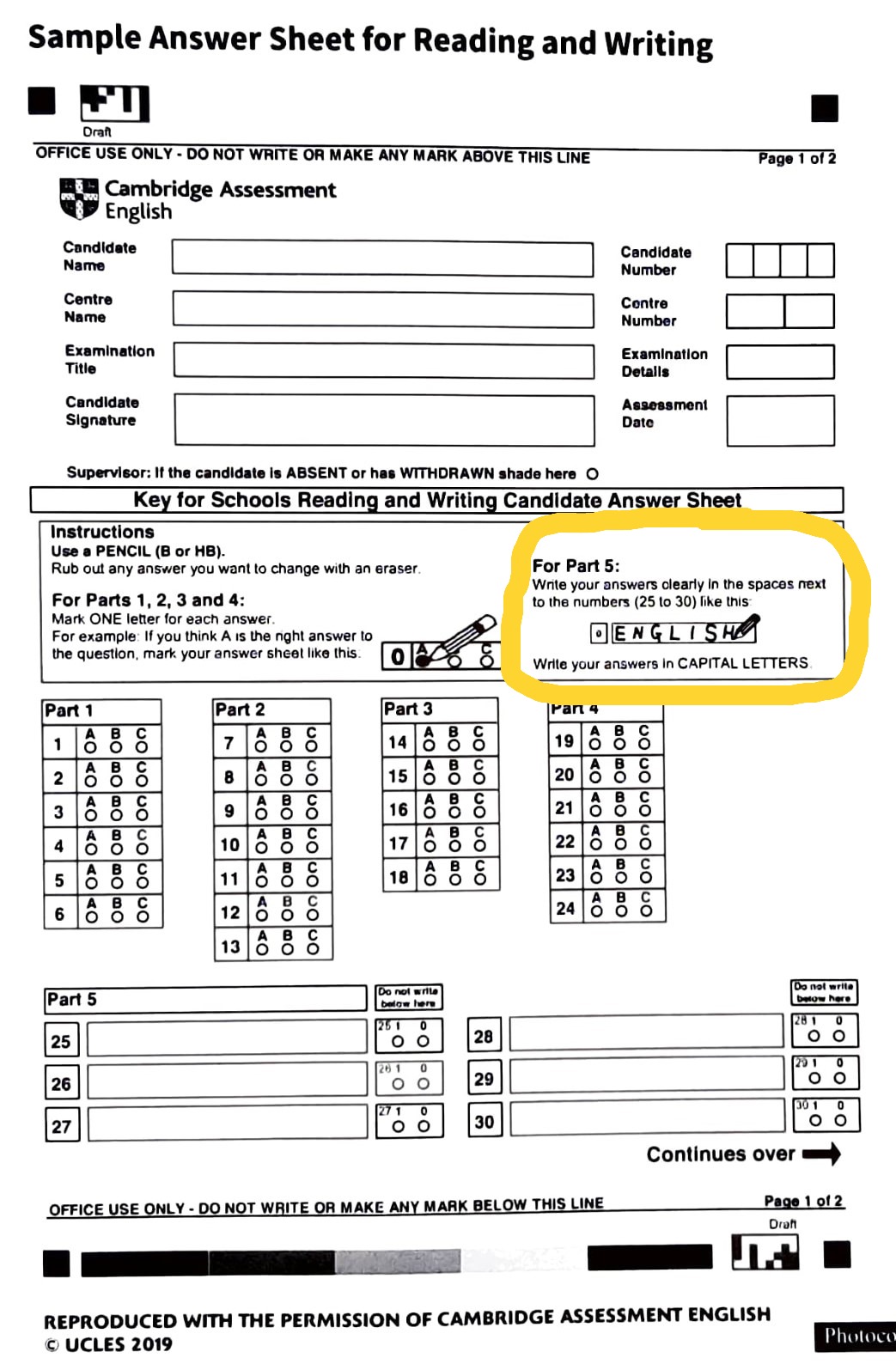 |
| Write in CAPITAL LETTERS |
TAKE NOTE:
- Be careful to transfer your answers correctly. Stay inside the circles. Make sure they are dark and shiny. Fate attenzione quando trasferite le risposte all' answer sheet e riempite bene gli spazi in maniera precisa, lucida e scura
.png) .
.
- ERASE well. Do NOT leave two answers on one line. Non lasciate traccia di cancellatura.
- Answer ALL the questions. If you aren't sure, GUESS! NON lasciate nulla in bianco. Se non siete sicuri, indovinate!
- If you have bad handwriting, use CAPITAL LETTERS for your email and story. You MUST write in CAPITAL letters for part 2 of the Listening and Part 5 of the Reading. Scrivete più leggibile possibile. Se non avete una buona scrittura, scrivete in STAMPATELLO MAIUSCOLO.
NOTA BENE: E' obbligatorio scrivere in STAMPATELLO in Part 2 del Listening e in Part 5 del Reading. - Copy correctly! Spelling counts! Copiate perfettamente le risposte. Conta anche lo spelling!
- Part 6: Iniziate la lettera con Dear / Hi / Hello e il nome della persona a cui stai scrivendo, seguito dalla vergola. Andate a capo e iniziate la prima parola con una lettera MAIUSCOLA. Rispondete ai tre quesiti. È necessario leggere le istruzioni della lettera con attenzione e rispondere alle domande.
Chiudete con frasi come From, / Love, / Your friend, /See you soon. / Bye for now, e firmate. Do NOT close with Bye bye. - Remember to count and write the number of words. You must write at least 25. Do not count the opening (Hi Mary,) or your name.
Scrivete il numero di parole (un minimo di 25). Sarete penalizzate se scrivete meno di 25. Non contate l'apertura (Hi Mary,) o vostro nome. - Fate attenzioni agli errori di ortografia. Dovete sapere come scrivere le parole della Vocabulary List. I giorni della settimana iniziano con la lettera maiuscola, come la parola (io) "I" e la prima parola di ogni frase.
- STUDY the vocabulary lists on this blog.

.png)
Saturday, February 15, 2025
2) Speaking part 2: School subjects + Shopping + Fun activities
Be sure you have read through the other SPEAKING POSTS.
PHRASES to use:
- In my opinion
- What's your opinion?
- I personally think/feel
- I really think/believe that
- What do you think?
- I prefer
- Which/What do you prefer?
- I don't really care for
Do you like these school subjects?

Do you think:
- maths is important?
- geography is useful?
- history is interesting?
- science is fun?
- art is easy?
Which of these subjects do you like best?
Do you like learning alone or with a teacher?
What sort of homework do you prefer; reading something or writing something? (Why?)
Saturday, February 8, 2025
Part 6: EMAIL PRACTICE
Practice writing the emails below. Be sure to answer all 3 questions in each email. Write 25 words or more.
1) Hi,
It’s great that you’re free to meet me
this weekend. I have a few questions. Where is the best place in your town to meet? What would you like to do? Shall I bring anything?
Write soon!
Francis
2) You are planning a party. Write an email to your English friend Malcolm. In your email:
Tell Malcolm about your party.
Ask if Malcolm wants to come.
Suggest what Malcom should bring.
Monday, January 20, 2025
Writing Part 6- The email
- You must write a message of 25 words or more. Do not count your name or the opening salutation.
- Use GOOD handwriting. You will not be penalized if you write in CAPITAL LETTERS. The DIGITAL exam allows you to type into text boxes, so it is easy to edit, delete, and move text.
- ***Remember: you can always respond, even when you don't know what all the words mean.
HOW TO WRITE your message:
1. Use the same format you see on the test. Begin with a salutation: Hello / Hi + name of the person you are writing to, followed by a comma: Hi Bob,
2. Start a new paragraph and begin with a CAPITAL letter.
3. Answer all 3 parts.
1. Use the same format you see on the test. Begin with a salutation: Hello / Hi + name of the person you are writing to, followed by a comma: Hi Bob,
2. Start a new paragraph and begin with a CAPITAL letter.
3. Answer all 3 parts.
4. End your letter with: See you soon. / See you later. / Let me know. / Talk to you soon. / Your friend, / Love, / Bye for now,
5. Sign your name
6. Count the words (excluding the beginning salutation and your name).
5. Sign your name
6. Count the words (excluding the beginning salutation and your name).
Here is an example of an email with ideas of what to write:
You need to choose a friend to do your school project with. Write an email to your school friend Tim.
- ask Tim to do the project with you;
- say when you can meet
- tell Tim what to bring
Hi Tim,
Would you like to do the school project with me? (10 words)
Can you do the school project with me? (8 words)
Will you do the school project with me? (8 words)
We can meet at my house after basketball practice. (9 words)
We can meet after school in the library. (8 words)
We can meet at 5 p.m. (5 words)
I would like to meet...
Please bring your computer and your dad's digital camera. (9 words)
Bring a notebook and your mobile phone. (7 words)
Can you do the school project with me? (8 words)
Will you do the school project with me? (8 words)
We can meet at my house after basketball practice. (9 words)
We can meet after school in the library. (8 words)
We can meet at 5 p.m. (5 words)
Why don't we meet....?
Let's meet....
How about meeting....?Let's meet....
I would like to meet...
Please bring your computer and your dad's digital camera. (9 words)
Bring a notebook and your mobile phone. (7 words)
Let me know. (3 words)
See you soon.
Write me soon.
Bye for now.
Your friend, (2 words)
Sign your name
Now it's your turn.
1 Answer this email from your English friend Joe. Write at least 25 words.
1 Answer this email from your English friend Joe. Write at least 25 words.
 |
2 Answer this email from your friend Liam. Remember, you must write at least 25 words.
3 Write an email to Sam and answer the questions. Write 25 words or more.
Hi,For help with LIKE, click HEREHi,I'm going to be in your town next week. Could you tell me about a good place to eat? What's the food like? Where is it?Thanks,Liam
3 Write an email to Sam and answer the questions. Write 25 words or more.
I want to ask you something. I'm really bored. Can I borrow something to read from you? What do you think I will enjoy? And when would you like it back?
I hope it's OK. Cheers!
Sam
4 Read this note from your friend, Sarah. Respond and answer her questions. Write 25-35 words.
Thank you for asking your brother to meet me at the bus station tomorrow. What does he look like? What clothes will he wear? Where will he wait for me?
See you soon!
Thank you for asking your brother to meet me at the bus station tomorrow. What does he look like? What clothes will he wear? Where will he wait for me?
See you soon!
Sarah
5 You've been invited to a barbecue on Sunday. Write an email to your friend Valeria. Say:
- why you will be late
- what time you will get there
- what food you will bring
Try this Listening test
PART 1
REMEMBER: You will hear something about all 3 pictures, so pay attention to the questions and listen for specific information. Are the verbs in the present, past, or future?
PART 1
Questions 1-5. You will hear five short conversations. You will hear each conversation twice. There is one question for each conversation. For each question, choose the correct picture (A, B, or C).
Wednesday, April 12, 2023
Part 7 STORY Writing practice
.jpg)
Look at the three pictures. Write the story shown in the pictures.
Write 35 words or more. You can hand in your work or write your stories in the comments section below. For more stories, click HERE.
The more you write, the easier it gets and the better you become!


Sunday, March 5, 2023
Writing part 7 - The Story
Question 32
Look at the three pictures.
Write the story shown in the pictures.
Write 35 words or more.
You must write about all 3 pictures.
You should write a rough draft on paper before transferring the final copy to your answer sheet. Be sure to write CLEARLY. You can write in capital letters if you like.
You must write about all 3 pictures.
You should write a rough draft on paper before transferring the final copy to your answer sheet. Be sure to write CLEARLY. You can write in capital letters if you like.
Things to think about:
- where the people were and what they were doing;
- when it was (season, day); what the weather was like;
- the names of the people:
- what they were wearing, objects they were carrying, how they were feeling.
Example:
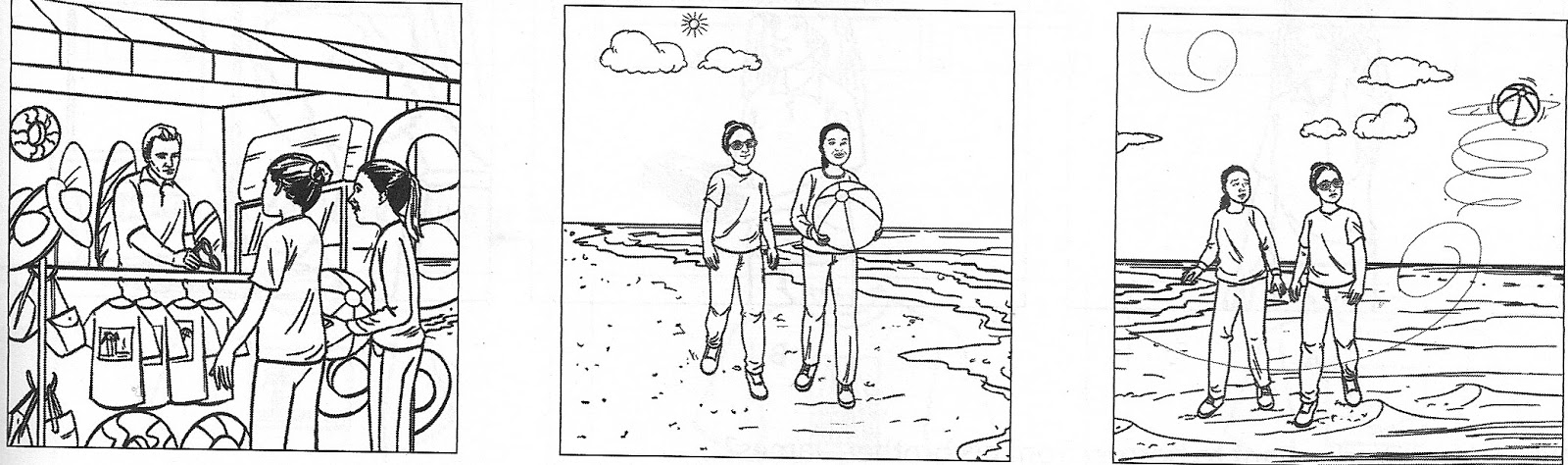
Mary and Martha went on holiday last weekend. It was a beautiful, sunny day, so they bought some sunglasses and a big ball. When they got to the beach, the weather started to change. It became so windy that while they were playing with their ball, the wind blew it away. (51 words)
Thursday, March 2, 2023
Sunday, February 13, 2022
The Speaking Test
Speaking is always a very important part of any exam.
Speaking Part 1
PERSONAL INFORMATION
- There are 2 examiners: one will speak to you, the other will take notes.
- You will have a partner. It will last 8 - 10 minutes.
- If there is an odd number of students, the last group will be a group of 3 and will last 13 -15 minutes.
Speaking Part 1
PERSONAL INFORMATION
This part lasts about 3 -4 minutes.
Click HERE to see pp. 24 - 32 for the vocabulary of the topics above.
Watch the videos of the new exam format:
The examiner will ask each student questions. The most common exam questions are about:
You should be able to talk about these topics below:
- Where you are from
- School and the subjects you study
- Family
- Your home town
- Freetime activities
- Your likes and dislikes
You should be able to talk about these topics below:
- Appliances
- Clothes and Accessories
- Colors
- Communication and Technology
- Documents and Texts
- Education
- Entertainment and Media
- Family and Friends
- Food and drink
- Health, medicine, and exercise
- Hobbies and leisure (Free Time Activities)
- House and home
- Measurements
- Personal feelings, opinions, and experiences
- Places (town, city, countryside) and Buildings
- Services
- Shopping
- Sports
- The natural world
- Time
- Transport
- Travel and Holidays
- Weather
- Work and jobs
For some typical A2 level questions click HERE (for older students) and HERE
Speaking Part 2
In this part, students talk to each other.
There are 5 pictures to talk about one of the topics above. You will say why you like or don't like something. You will compare, describe, and give your opinion.
Then the examiner will ask some questions on the same topic.
It will last about 5 -6 minutes.
Speaking Part 2
In this part, students talk to each other.
There are 5 pictures to talk about one of the topics above. You will say why you like or don't like something. You will compare, describe, and give your opinion.
Then the examiner will ask some questions on the same topic.
It will last about 5 -6 minutes.
Click HERE for possible questions in phase 2.
Watch the videos of the new exam format:
Thursday, February 3, 2022
The Official list of Vocabulary you should know for the test (Updated August 2025):
Introduction and explanation.....p. 2
Words in alphabetical order........p. 4
Word sets .....................................................p. 24
Vocabulary by topic ...........................p. 25
Words in alphabetical order........p. 4
Word sets .....................................................p. 24
Vocabulary by topic ...........................p. 25

Wednesday, February 2, 2022
General Information about the test
The READING and WRITING test lasts 1 hour. There are 7 parts and 32 questions.
Part 1: Six short real-world texts.
Part 2: Three short texts on one topic..jpg) Part 3: One long text for details.
Part 3: One long text for details.
Part 4: Choose the correct vocabulary for the text.
Part 5: Complete the gaps with your own words.
Part 6: Write a short email or note (25 words or more).
Part 7: Write a short story (35 words or more).
You should not spend more than 20 minutes on the email and story part.
The LISTENING test lasts about 30 minutes. There are 5 parts and 25 questions.
Part 1: Five short dialogues. Choose the correct picture.
Part 2: Taking notes (1 word, a number, a date, or a time).
Parts 3 and 4: Choose the correct answer for dialogues.
Part 5: A dialogue with a matching exercise.
For paper version: you must use pencils and erasers on special answer sheets. No pens.
The SPEAKING test lasts about 8-10 minutes. You will have a partner. You can choose your partner. If there is an uneven number of students, the last group will be a group of three and will last 13 - 15 minutes. There are 2 parts to the Speaking Test. In the first part, the examiner will ask you questions. In the second part, you will discuss some pictures with your partner, saying why you like or dislike what you see.
(See the speaking post below).
Work on the areas that are most difficult for you.
Know the ALPHABET, and study the VOCABULARY LISTS.
Part 1: Six short real-world texts.
Part 2: Three short texts on one topic.
.jpg)
Part 4: Choose the correct vocabulary for the text.
Part 5: Complete the gaps with your own words.
Part 6: Write a short email or note (25 words or more).
Part 7: Write a short story (35 words or more).
You should not spend more than 20 minutes on the email and story part.
The LISTENING test lasts about 30 minutes. There are 5 parts and 25 questions.
Part 1: Five short dialogues. Choose the correct picture.
Part 2: Taking notes (1 word, a number, a date, or a time).
Parts 3 and 4: Choose the correct answer for dialogues.
Part 5: A dialogue with a matching exercise.
For paper version: you must use pencils and erasers on special answer sheets. No pens.
The SPEAKING test lasts about 8-10 minutes. You will have a partner. You can choose your partner. If there is an uneven number of students, the last group will be a group of three and will last 13 - 15 minutes. There are 2 parts to the Speaking Test. In the first part, the examiner will ask you questions. In the second part, you will discuss some pictures with your partner, saying why you like or dislike what you see.
(See the speaking post below).
Work on the areas that are most difficult for you.
Know the ALPHABET, and study the VOCABULARY LISTS.
Tuesday, February 1, 2022
Learning English
Sometimes we lack the words to express what is most important to us. That's when we just need to learn them.
Watch this video and answer the questions below.
How do you learn 


Monday, January 31, 2022
WELCOME to the KET KIDS Practice Pages
This is where you can find messages, homework, and extra help to prepare for the KEY for Schools certification. 

- Click on the links to practice different types of exercises.
- Study the vocabulary lists posted.
- If you need help, write in the comments section of the posts.
- You can keep updated by becoming a FOLLOWER (in the left-hand column)
Have fun!
Thursday, April 2, 2020
Wednesday, June 5, 2019
How to see your KET for Schools RESULTS
What did you think of the exam?
 How do you think you did?
Take the polls on the RIGHT side of the blog.
You can also write in the comments section below.
You will receive information with your ID number and Secret Number. Use these to register so you can see the results of your test. Register at:
https://candidates.cambridgeenglish.org/
See the new KET online statement.
If you have comments or questions, write in the comments section below.

Take the polls on the RIGHT side of the blog.
You can also write in the comments section below.
You will receive information with your ID number and Secret Number. Use these to register so you can see the results of your test. Register at:
https://candidates.cambridgeenglish.org/
See the new KET online statement.
If you have comments or questions, write in the comments section below.
Thursday, May 23, 2019
Grammar notes on writing exercises
Writing dates: 18 May / 18th May / May 18 / May 18th
Money signs come BEFORE the number: £ 10, € 10, $10
Do not dot (.) a capital I !
NO: "It's start"
YES: "It starts"
Borrow vs Lend:
If I lend you money, I give it to you. If I borrow money, you give it to me.
Could I borrow your pencil, please?
I lent Bob my dictionary.
ON foot, BY car, bus, train, plane
Spelling is important!
Count part 9 correctly. You MUST have 25-35 words.
Money signs come BEFORE the number: £ 10, € 10, $10
Do not dot (.) a capital I !
NO: "It's start"
YES: "It starts"
Borrow vs Lend:
If I lend you money, I give it to you. If I borrow money, you give it to me.
Could I borrow your pencil, please?
I lent Bob my dictionary.
ON foot, BY car, bus, train, plane
Spelling is important!
Count part 9 correctly. You MUST have 25-35 words.
Tuesday, May 14, 2019
SPEAKING - some problems
PRIZES (premi)  Prices (prezzi)
Is it always sunny?
Prices (prezzi)Have you ever won a prize? What is the price of (a ticket)?
cost?
How much is it? / How much are they?
How much does it cost? / How much do they cost?
£1400 = "one thousand four hundred pounds"
£19.50 = "nineteen pounds, fifty"
€ 4.75 = four euros and seventy-five cents
"That's four seventy-five, please."
"That'll be four seventy-five, please."
$122.33 = one hundred twenty-two dollars and thirty-three cents
cost?
How much is it? / How much are they?
How much does it cost? / How much do they cost?
£1400 = "one thousand four hundred pounds"
£19.50 = "nineteen pounds, fifty"
€ 4.75 = four euros and seventy-five cents
"That's four seventy-five, please."
"That'll be four seventy-five, please."
$122.33 = one hundred twenty-two dollars and thirty-three cents
Whose party is it? It's Hannah's party.
What is the food like? It's spicy. / It's very good.
What is the weather like? It's sunny and warm.
Is eating out expensive? / Is it expensive to eat out?
No, it's not expensive. It's cheap.
What is the weather like? It's sunny and warm.
Where does it take place? It takes place in the city center.
eat?
Can you eat there?
food?
Is there any food there?
What kind of food is there?
transport?
How will/can we get there?
What kind of transport will/can we use?
food?
Is there any food there?
What kind of food is there?
transport?
How will/can we get there?
What kind of transport will/can we use?
How/get there?
How can you get there?
How do we get there?
How do we get there?
(You can get there...) BY bus / train / boat / car
ON foot
always sunny?ON foot
Is it always sunny?
What/see?
What can you see there?
What will we see there?
What will we see there?
age?
How old is it? / How old is he/she?
car park?
Is there a car park?
Is there a car park?
more information?
Can you give me more information, please?
Where can I get more information?
How can I get more information?
Wear?
What should I wear? (you, we)
What do I/you/we have to wear?
What should I wear? (you, we)
What do I/you/we have to wear?
What/clothes?
What clothes should I wear? / What should I wear?
What/bring
What should I bring?
What can I bring?
What clothes should I wear? / What should I wear?
What/bring
What should I bring?
What can I bring?
long/journey?
How long is the journey?
How long is the journey?
Is the journey long?
good/food
Is the food good?
Do they have good food?
book/place (book means prenotare)
How can I book a place?
Can I book a place?
When?
When is it? (the party, the competition)
When/open?
When it is open?
April 25 or 25 April = "on the twenty-fifth of April" OR "April twenty-fifth."
good/food
Is the food good?
Do they have good food?
book/place (book means prenotare)
How can I book a place?
Can I book a place?
When?
When is it? (the party, the competition)
When/open?
When it is open?
April 25 or 25 April = "on the twenty-fifth of April" OR "April twenty-fifth."
November - January = "from November to January"
9 - 5 = "from nine to five"
Rd = Road
1900 = nineteen hundred
NOTE ON NUMBERS:
1st = first
31st = thirty-first
2nd = second
22nd = twenty-second
3rd = third
23rd = twenty-third
5th = fifth
9th= ninth
12th = twelfth
@ = at
www.english.com = Double u-double u-double u - dot - English - dot - com
Rd = Road
1900 = nineteen hundred
NOTE ON NUMBERS:
1st = first
31st = thirty-first
2nd = second
22nd = twenty-second
3rd = third
23rd = twenty-third
5th = fifth
9th= ninth
12th = twelfth
@ = at
www.english.com = Double u-double u-double u - dot - English - dot - com
If you have any questions or if there are other problem questions to add, please write them in the comments section below.
Monday, May 6, 2019
Part 5 exercises (Old part 7)


Hi Rob,
I ____________ just thinking about the party on Saturday. Will ____________ be bringing any music? I need to know so that I can ______________ someone else to if you can't. I was also thinking about ___________ you said today about inviting Hannah. I think it's a ________ idea. I'll invite her tomorrow when I ________ her in maths class.
What are you ___________ tomorrow after school? Why don't you come over to my place to help ________ with _________ party arrangements? You could stay for dinner and my mum could __________ you home later. Let me __________.
Bye for now,
Tom
Part 6 - Vocabulary (old version)
- You can listen to music with this present. MP3 player
- You can take photographs with this present. c _ _ _ _ _
- You put this on your wall and it may be a picture of a sports star. p _ _ _ _ _
- If you get this as a present, you may want to ride it around the park. b _ _ _
- If you are given this, you can choose what to buy. m _ _ _ _
- This is very sweet and you shouldn't eat too much of it. c _ _ _ _ _ _ _ _
- You sit at this to eat your meals. t _ _ _ _
- This is where you wash the plates. s _ _ _
- You can keep plates and glasses inside this. c _ _ _ _ _ _ _ _
- This is the type of dish you use for soup. b _ _ _
- You put food on this or inside to make it hot. c _ _ _ _ _
Write your answers in the comments section below.
Subscribe to:
Posts (Atom)