Showing posts with label Testing. Show all posts

Wednesday, March 26, 2025

Speaking - part 2 - TV Programs + ways to travel

(5 - 6 minutes) 
In this part, you will talk with your partner. Here are some pictures that show different television programs. Do you like these different types of television programs?  Say why or why not. Now talk together.


Things to think about for your discussion: 
  • What people, places, and things do you see in the pictures?  
  • Do you like action films?
  • Do you think that the news on TV is sad/interesting?
  • Do you think watching football on TV is fun/exciting?
  • What do you think about history programs?
Be descriptive to show the vocabulary you know.  Ask your partner questions so you speak together.


After 1-2 minutes, the examiner will then ask each candidate a question, such as:
Do you think ...
  • watching action films on TV is exciting?
  • watching the news on TV is sad?
  • watching football matches on TV is interesting?
  • watching singing on TV is fun?
  • watching programs about history on TV is boring?
So Candidate A, which of these programs do you like best? And Candidate B, which do you like best? 
(Then you return the pictures)

Then he or she will ask you both some questions about the topic. (up to 2 min.)
Examples:

  • Do you prefer watching television alone or with other people, Candidate B? Why? And what about you, Candidate A? 
  • How much time do you spend watching television on different days of the week? Why?
That is the end of the test.

Do you think traveling by train is interesting?
Do you think traveling by plane is dangerous?
                              by boat is fun?
                              by bus is nice?
                              by camper is comfortable?
Which way of traveling is best?
Which way of traveling do you like best? 
Do you prefer traveling with family or friends? 
Do you prefer staying at home on your holidays or traveling? Why?

Monday, March 17, 2025

K4S Part 4 Reading / Stop + to vs. stop + -ing


What's the difference between: 
stopped + -ing  and stopped to    
CONSIDER: 
They stopped eating.  vs They stopped to eat.


Saturday, March 1, 2025

MISTAKES on the Mock Test

NB: La maggior parte degli errori sono dovuti alla disattenzione in classe.
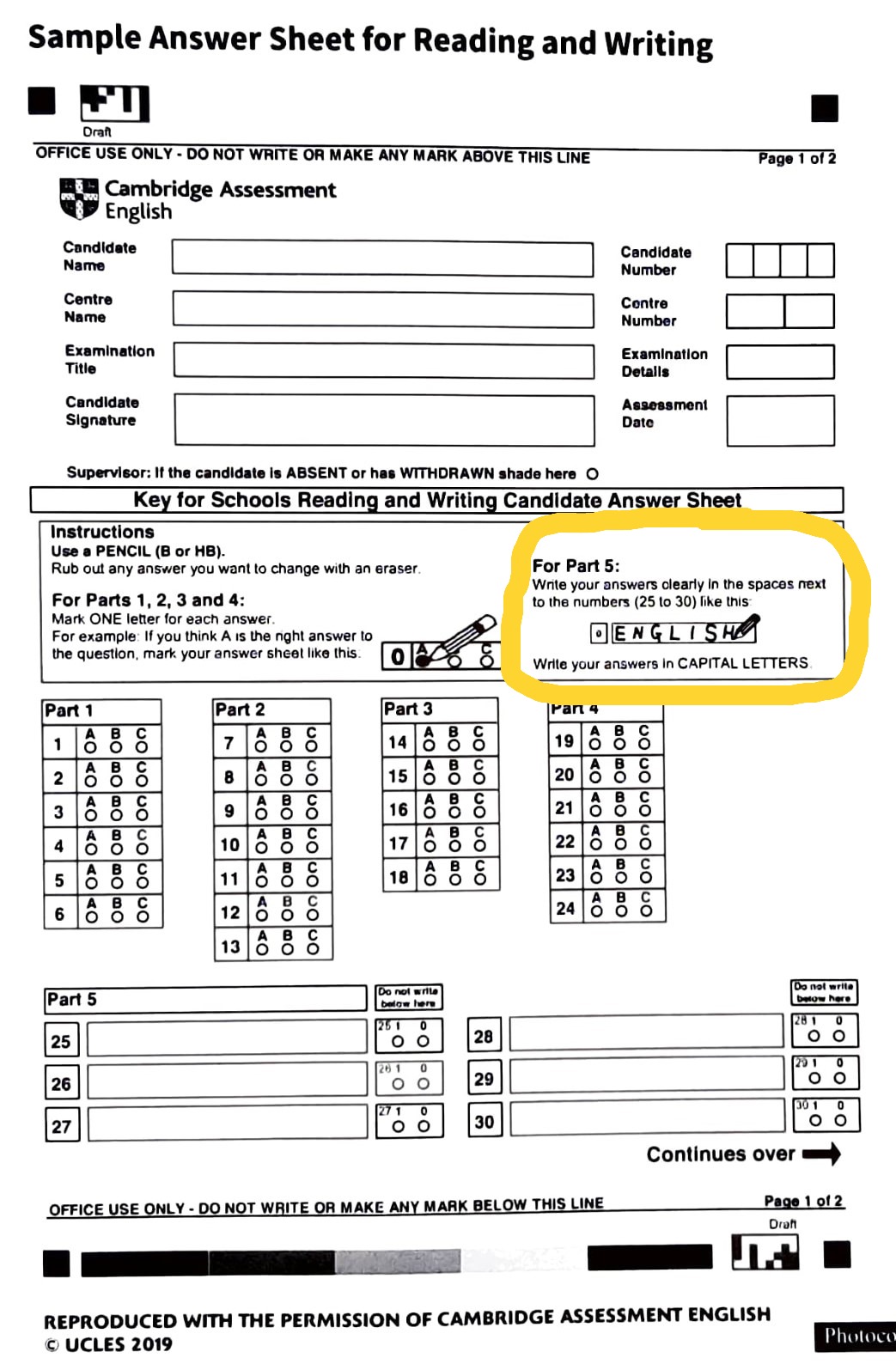
Many of you did not use the ANSWER SHEETS correctly.  
  1. Write BIG and DARK, so the examiner can read what you wrote!  
  2. Follow the INSTRUCTIONS! In listening part 2 and R+W Part 5,  you MUST write the words in CAPITAL LETTERS.  
  3. Listening:  Use the 10-15-20 seconds given to read the information! It helps to know what they will be talking about. 
  4. You must transfer ALL of your answers to the answer sheets.  Be sure to copy correctly from the booklet to your answer sheet.  Do not leave anything blank. Guess! You might be correct.  
  5. You must ERASE well.  Leave only one answer on each line.  Do not write anything other than your aswers in the correct spaces or write in the areas it says not to. Be careful when you erase. If necessary letters are missing [scarf(scarf)],  the word will be considered misspelled and a mistake. 
  6. You have 6 minutes to transfer your answers to the answer sheet in the listening. You must stop writing and put your pencil down when the time is up. There is one hour for the R+W INCLUDING the transfer time, so remember to give yourself enough to transfer your answers.
  7. The circles must be filled in well.Stay within the circle. Make sure they are DARK and SHINY.   DO NOT cross them out.  


COMMON MISTAKES
  1.  Write only 1 word in Listening Part 2 and R+W Part 5.
  2.  Know the Alphabet! In Listening part 2  and in Writing part 5,  you must spell correctly.   Do not misspell words like Hi,  days of the week, with, because, snack, jacket, which, what, together
  3.  Use capitals appropriately: at the beginning of a sentence, for names (Chris), days of the week, months. If you do not, the answer will be counted as incorrect. (NOT i) !
  4.  PUNCTUATION is important!  Sentences end with full stops / periods (.), exclamation marks (!), or question marks (?)  not commas ( , ).
  5. You come last:  My friends and I   not Me and my friends.
  6. You go TO town  / we went to a concert
  7. House is the building; Home is used in a more personal way:
              Can you come over to my house this weekend?
              I have to be home before midnight. 
  8.  It is best to write the story in the past tense. You can use the simple past and the past continuous:  Bob and Mary were walking in the park when they saw a huge tree with a big hole in it. 
    If you use the present tense, use the continuous to make it better: 
    Bob and Mary are walking in the park when they see a huge tree with a hole in it.  
    Know the difference between the present perfect and simple past. Be sure to write about all 3 pictures. It is a story, so they need to have a connection.
  9. . You can practice with the exercises in HELPFUL LINKS. 
  • PART 6- EMAIL.  DOVETE:
    • Leggere le istruzioni con attenzione, capire le 3 quisiti e a chi rispondere. 
    • Iniziare con  Hi / Hello+ Nome seguito da , della persona alla quale va indirizzata. 
    • Andare a capo e iniziare la prima parola con Lettera MAISUCOLA.
    • Rispondere alle tre quesiti. 
    • Chiudere con una frase adatta. 
    • Firmare tuo nome.
    • Contare le parole scritte.  Non scrivere meno di quanto richiesto. 
      SEE EMAIL POSTS

Saturday, February 22, 2025

MOCK EXAM; classes 2025: READ THIS POST CAREFULLY!

The Mock Test (READING, WRITING, and LISTENING) will be on 
 Monday, February 24
Wednesday, February 26
Thursday, February 27.


Write in CAPITAL letters in Part 2

PLEASE BE ON TIME. 


Remember that you will use special answer sheets, so you must have  2 (#2hb) PENCILS and an ERASER.  Cell phones must be turned off or silenced. 
Write in CAPITAL LETTERS


  TAKE NOTE:
  1. Be careful to transfer your answers correctly. Stay inside the circles. Make sure they are dark and shiny.   Fate attenzione quando trasferite le risposte all' answer sheet e riempite bene gli spazi in maniera precisa, lucida e scura.   
     
  2. ERASE well. Do NOT leave two answers on one line. Non lasciate traccia di cancellatura.

  3. Answer ALL the questions. If you aren't sure, GUESS! NON lasciate nulla in bianco. Se non siete sicuri, indovinate! 

  4.   If you have bad handwriting, use CAPITAL LETTERS for your email and story.  You MUST write in CAPITAL letters for part 2 of the Listening and Part 5 of the Reading.  Scrivete più leggibile possibile. Se non avete una buona scrittura, scrivete in STAMPATELLO MAIUSCOLO.  
    NOTA BENE: E' obbligatorio scrivere in STAMPATELLO in Part 2 del Listening e in Part 5 del Reading. 

  5. Copy correctly! Spelling counts! Copiate perfettamente le risposte. Conta anche lo spelling!  

  6. Part 6: Iniziate la lettera con Dear / Hi / Hello e il nome della persona a cui stai scrivendo, seguito dalla vergola. Andate a capo e iniziate la prima parola con una lettera MAIUSCOLA. Rispondete ai tre quesiti. È necessario leggere le istruzioni della lettera con attenzione e rispondere alle domande.
    Chiudete con frasi come From, / Love, / Your friend, /See you soon. / Bye for now, e firmate.  Do NOT close with Bye bye.

  7. Remember to count and write the number of words. You must write at least 25.  Do not count the opening (Hi Mary,) or your name.
    S
    crivete il numero di parole (un minimo di 25). Sarete penalizzate se scrivete meno di 25. Non contate l'apertura (Hi Mary,) o vostro nome. 

  8. Fate attenzioni agli errori di ortografia. Dovete sapere come scrivere le parole della Vocabulary List I giorni della settimana iniziano con la lettera maiuscola, come la parola (io) "I" e la prima parola di ogni frase.

  9. STUDY the vocabulary lists on this blog.