Showing posts with label General Info. Show all posts

Wednesday, June 3, 2026

THE TEST rules and last minute information

The test will be on Thursday, June 11:
Reading, Writing, and Listening - 11:30
Speaking - 13:45

  • Be at school at least 15 minutes before each exam time.
  • The Listening test lasts about 30 minutes, including 2 minutes transfer time;
  • The Reading and Writing tests last 1 hour and 10 minutes, including transfer time.  
  • SPEAKING lasts 8-10 minutes or 15 minutes for a group of three. Be prepared with your partner. Keep silent while waiting. 
  • There will be a short break between the tests. 
  • You will have ASSIGNED SEATS. There will be a name tag on each desk.
  • You can BRING pencils, pens, an eraser, and a bottle of water into the exam room, but nothing else. You can ask for paper to take notes. Leave it on your desk when you finish the exam.
  • If you need help, raise your hand. You CANNOT ask what a word means. Try to understand the meaning from the context.
  • You will receive a password and the date when you can see your results online. You can register on the Cambridge site for the results. 
Remember the RULES:
  1. Bring your ID card or passport (with photo).  
  2. Check that your name has been spelled correctly on all of the exam documents. If incorrect, notify someone immediately.
  3. Dress appropriately. You cannot wear any clothes with English words or phrases on them. 
  4. No gum.  
  5. No noisy jewelry.
  6. All electronic devices must be turned off and are not allowed in the exam rooms. 
  7. All bags, purses, backpacks, and phones must be left outside the exam room.
  8. DO NOT talk during the exam; DO NOT look around at the other students. Focus on your own work!
  9. Follow all instructions. Don't leave anything blank.
  10. Sit quietly if you finish early, CHECK your work. Do not get up until they say you can.
  11. MAKE SURE that you have answered EVERY question and that you have copied your answers correctly. 
You can read the official rules HERE. If you have any questions, write in the comments section below. 

RICORDATE di:
  1. NON lasciare nulla in bianco! 
  2. Scrivere il più leggibile possibile! Niente lettere strane. Niente linguaggio "sms".
  3. Ripassare i vocaboli. Spelling conta.. 
  4. Iniziare la lettera con "Dear / Hi / Hello".  Andare a capo e iniziare la prima parola con la lettera Maiuscola. È necessario leggere le istruzioni della lettera con attenzione!  Rispondere ai tre quesiti. Chiudere con "From / Love / Your friend / See you soon / Bye for now" e firmare. Do NOT use "Goodbye,"  "Bye" or "kisses" when you close your letter. Seguire la forma corretta. Scrivere sempre da 25 a 35 parole.
L'esame si fa in silenzio (no chewing gum!)  Concentratevi sul proprio lavoro. Non giratevi intorno o parlare. Significa il ritiro dell'esame. 
Ricordatevi di portare un DOCUMENTO DI IDENTITA' VALIDO CON FOTO. 
NON PORTATE CELLULARI NE' SMARTWATCH. 

Esame Cambridge A2 Key for Schools – Informazioni Utili
Di seguito i dettagli e gli orari per la giornata d'esame che si terrà giovedì 11 giugno presso la Scuola Media IC 1 Piombino:
  • Si raccomanda di arrivare 15 minuti prima dell'inizio di ogni prova.
  • I candidati dovranno avere con sé: Documento d'identità valido (carta d'identità o passaporto).
    Una penna a sfera nera o blu.
    Una matita, una gomma e un temperamatite.
  • Non è assolutamente consentito tenere con sé:
    Telefoni cellulari, smartwatch, orologi o qualsiasi altro dispositivo elettronico.  Questi oggetti devono essere
    lasciati fuori la stanza prima dell'inizio delle prove.
You can do this! 
Don't stress. Do your best. 

Monday, April 20, 2026

Let's communicate!

 When you don't understand, be honest and say so.


Sometimes people just speak too quickly. Remind them:
  Would you mind speaking more slowly, please?


 If you forget a word or don't know the right one to use, explain it:
  • someone/somebody/a person - It's someone who
    works with students and wants them to learn.
  • something / a thing - It's something you use when you want to remove what you write.  
  • somewhere / a place - It's a place people go to when they are hungry.
  • They take care of us when we're sick.
  • It has two wheels, gears, brakes, pedals, and handlebars. We use it to get around the town.  
  • It's where we stay when we travel. It usually has a swimming pool.


Monday, April 13, 2026

Getting to Know You


Introducing yourself:

Mary:  Hi, I'm Mary.  

George: Hello, Mary, I'm George. 

Mary:  Hi, George. // Nice to meet you, George.  // Nice meeting you. 

George:  Hi, Mary. // Nice to meet you, too, Mary.  //  Nice meeting you, too. 


When introducing another person, we use "THIS."

Bob:  Mary, this is George. George, this is Mary.

George: Hi, Mary. // Nice to meet you, Mary.

Mary: Hi George. // It's nice to meet you, too, George.


If you didn’t hear or understand someone's name: "I'm sorry, I didn't catch your name." "I’m sorry, what was your name again?”


Over the phone, in an office, or at school, someone may need more clarification:

"Could/can/would you spell that for me, please?"

"Is that with a C or K?"


When the conversation is over, the first to leave says: 

It was nice meeting you, (Mary). // It was nice to meet you.

The other person can respond:  It was nice meeting you, too. // It was nice to meet you, too.


  • In the 16th/17th century, Livorno [a.k.a. Liburnus in Latin; Livorna (1017); Livuorno, Liurono by Ferdinando de Medici (1593); Legorno; or Ligorna in Genoese] was a very important port for British merchants, who found it easier to pronounce the name as Leghorn.
  • The world-famous Tuscan Leghorn breed of chickens got its name because it was exported from that port to N. America in 1828.
  • In 1946, the Leghorn rooster became a cartoon character for Warner Bros.


Wednesday, March 26, 2025

Speaking Reminders

1. If you don't understand, you can say so.

Example, if the examiner asks, "Have you ever traveled abroad?" and you don't understand abroad, you can say: 
  • I'm sorry. I don't understand "abroad".
  • What does "abroad" mean?
  • What is "abroad"?
2. The clock is always ticking, so keep talking. Show that you understand the question and know the vocabulary.

Examples: 
If you can't remember what the weather was like or what you wore yesterday,  a true answer is not important.  
  • It was cold and rainy / It was warm and sunny. / It rained in the morning, but it was sunny in the afternoon.
  • I wore a new pair of trousers and a black sweater with a white blouse.
3.  In part 2, keep the cards on the table so both of you can see them.
if your partner can't find the answer, you can indicate it with your finger.

4. KEEP THINGS SIMPLE and CORRECT. 
Do not give more information than you should.  
Do not change the questions or the information on the cards. 

5. Review the speaking posts


Saturday, February 22, 2025

MOCK EXAM; classes 2025: READ THIS POST CAREFULLY!

The Mock Test (READING, WRITING, and LISTENING) will be on 
 Monday, February 24
Wednesday, February 26
Thursday, February 27.


Write in CAPITAL letters in Part 2

PLEASE BE ON TIME. 


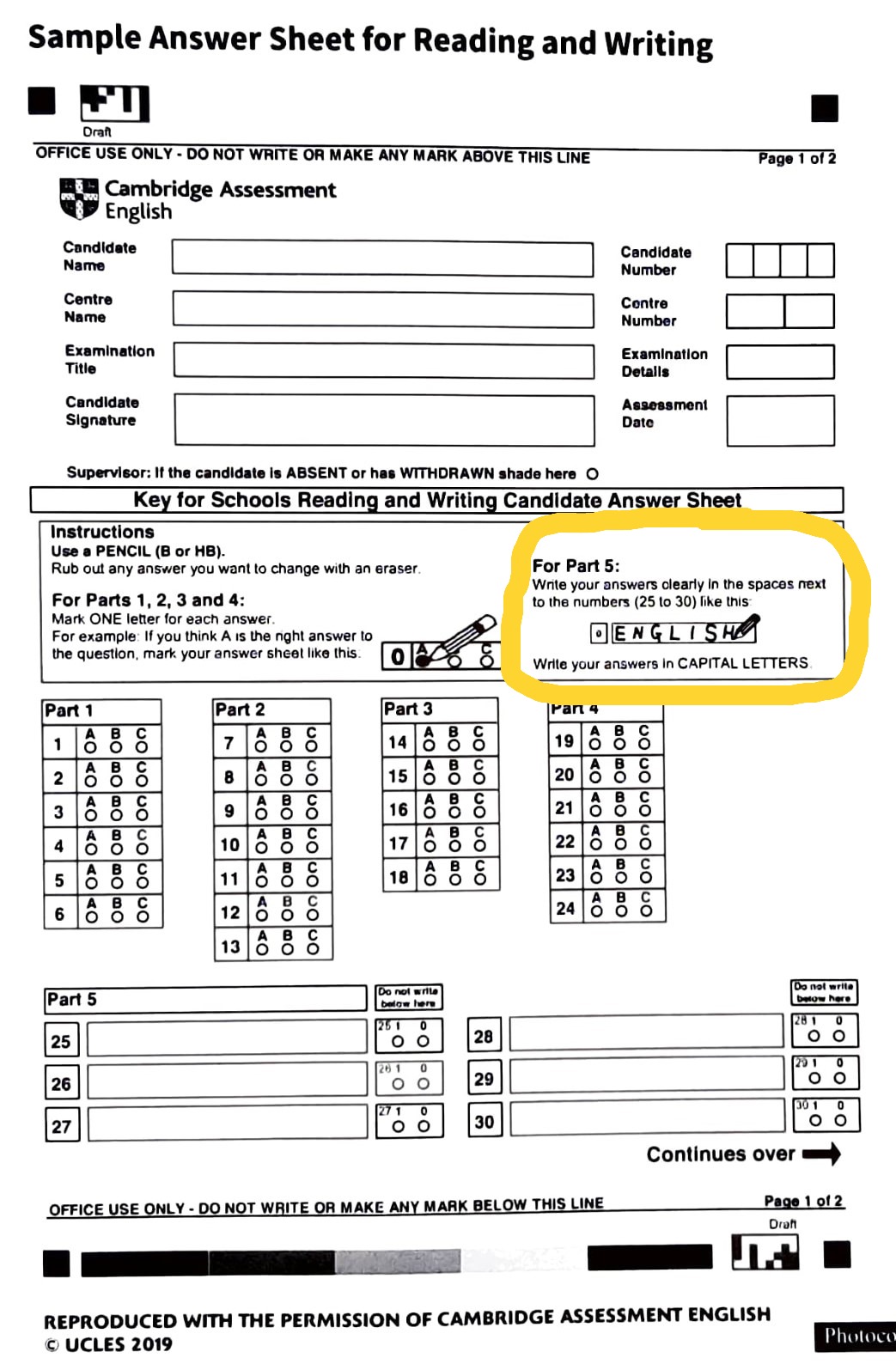
Remember that you will use special answer sheets, so you must have  2 (#2hb) PENCILS and an ERASER.  Cell phones must be turned off or silenced. 
Write in CAPITAL LETTERS


  TAKE NOTE:
  1. Be careful to transfer your answers correctly. Stay inside the circles. Make sure they are dark and shiny.   Fate attenzione quando trasferite le risposte all' answer sheet e riempite bene gli spazi in maniera precisa, lucida e scura.   
     
  2. ERASE well. Do NOT leave two answers on one line. Non lasciate traccia di cancellatura.

  3. Answer ALL the questions. If you aren't sure, GUESS! NON lasciate nulla in bianco. Se non siete sicuri, indovinate! 

  4.   If you have bad handwriting, use CAPITAL LETTERS for your email and story.  You MUST write in CAPITAL letters for part 2 of the Listening and Part 5 of the Reading.  Scrivete più leggibile possibile. Se non avete una buona scrittura, scrivete in STAMPATELLO MAIUSCOLO.  
    NOTA BENE: E' obbligatorio scrivere in STAMPATELLO in Part 2 del Listening e in Part 5 del Reading. 

  5. Copy correctly! Spelling counts! Copiate perfettamente le risposte. Conta anche lo spelling!  

  6. Part 6: Iniziate la lettera con Dear / Hi / Hello e il nome della persona a cui stai scrivendo, seguito dalla vergola. Andate a capo e iniziate la prima parola con una lettera MAIUSCOLA. Rispondete ai tre quesiti. È necessario leggere le istruzioni della lettera con attenzione e rispondere alle domande.
    Chiudete con frasi come From, / Love, / Your friend, /See you soon. / Bye for now, e firmate.  Do NOT close with Bye bye.

  7. Remember to count and write the number of words. You must write at least 25.  Do not count the opening (Hi Mary,) or your name.
    S
    crivete il numero di parole (un minimo di 25). Sarete penalizzate se scrivete meno di 25. Non contate l'apertura (Hi Mary,) o vostro nome. 

  8. Fate attenzioni agli errori di ortografia. Dovete sapere come scrivere le parole della Vocabulary List.  I giorni della settimana iniziano con la lettera maiuscola, come la parola (io) "I" e la prima parola di ogni frase.

  9. STUDY the vocabulary lists on this blog.


Saturday, March 11, 2023

Speaking Test Notes

The Speaking Test is with a partner. It has 2 parts and lasts about 8 - 10 minutes.  If there is an odd number of students, the last group will be a group of 3 and will last 13-15 minutes. 
Part 1: "getting to know you" questions; talk about yourself.
Part 2: the candidates talk to each other about pictures on a specific topic. Discuss a topic, talk about likes and dislikes, giving reasons. 

  1. There are 2 examiners. Both will give you marks, but only one will ask you questions. 
  2. Relax and have fun. The examiners want you to do well.
  3. Don't compare yourself to your partner.  Students are marked individually. 
  4. Listen and react to what the examiner and your partner say, but don't interrupt.  In the 1st part, you will speak to the examiner. In part 2, to your partner. Be prepared to ask them questions and start the discussion. 
  5. Speak clearly and loud enough for both examiners to hear you.
  6. Answer in full sentences, not just one word.
  7. You can ask the examiner to repeat the instructions. This will not affect your score.  REMEMBER that REPEAT means to say something again.
  8. If you don't understand, say so. For example, if the examiner asks, "Which foreign languages are you studying?" and you don't understand foreign, you can say: 
        • I'm sorry. I don't understand "foreign".
        • What does "foreign" mean?
        • What is "foreign"?
        9. If you can't remember a word you would like to use, explain it: 
  • "I can't remember the word. It's something we use to keep our pens and erasers in." (Are you talking about a pencil case?)
  • "We usually wear them in the winter when it's cold; not shoes, but those things we wear on our feet and cover our ankles or go up higher on our legs."  (Do you mean boots?)
        10. The clock is always ticking, so keep talking. Show that you understand the question and know the vocabulary.   Don't worry if the  examiner stops you.  This is due to the time limit. All candidates are given equal time. 
        11. A true answer is not always necessary.  If you can't remember what the weather was like, what you had for lunch, or what you wore yesterday, don't say you don't remember. You can answer anyway:
  • It was cold and rainy / It was warm and sunny. / It rained in the morning, but it was sunny in the afternoon.
  • I had a ham and cheese sandwich with some chips. / I had pasta with tomato sauce, some chicken and a salad. 
  • I wore jeans,  a hoodie], and trainers.  / I wore a sweatsuit** because I had football practice after school.
    (*hooded sweatshirt; **tracksuit, sweats, sweatpants and sweatshirt)
       
Be sure to see the other posts on Speaking and watch the videos of some speaking tests. 

Thursday, March 2, 2023

Sunday, February 13, 2022

The Speaking Test

 Speaking is always a very important part of any exam. 
  • There are 2 examiners: one will speak to you, the other will take notes. 
  • You will have a partner. It will last 8 - 10 minutes. 
  • If there is an odd number of students, the last group will be a group of 3 and will last 13 -15 minutes. 

 Speaking Part 1 

 PERSONAL INFORMATION
This part lasts about 3 -4 minutes.
The examiner will ask each student questions. The most common exam questions are about:
  1. Where you are from 
  2. School and the subjects you study
  3. Family
  4. Your home town
  5. Freetime activities
  6. Your likes and dislikes
First, they will ask you your name, age and where you live, then they will say something like: "Now let's talk about school." 

You should be able to talk about these topics below:  
            1. Appliances
            2. Clothes and Accessories
            3. Colors
            4. Communication and Technology
            5. Documents and Texts
            6. Education
            7. Entertainment and Media
            8. Family and Friends
            9. Food and drink
            10. Health, medicine, and exercise
            11. Hobbies and leisure (Free Time Activities)
            12. House and home 
            13. Measurements 
            14. Personal feelings, opinions, and experiences 
            15. Places (town, city, countryside) and Buildings
            16. Services 
            17. Shopping 
            18. Sports
            19. The natural world
            20. Time
            21. Transport
            22. Travel and Holidays
            23. Weather
            24. Work and jobs

Click HERE to see pp. 24 - 32 for the vocabulary of the topics above. 

For some typical A2 level questions click HERE (for older students) and  HERE

 Speaking Part 2 
In this part, students talk to each other. 
There are 5 pictures to talk about one of the topics above. You will say why you like or don't like something. You will compare, describe, and give your opinion.
Then the examiner will ask some questions on the same topic. 

It will last about 5 -6 minutes.

Click HERE for possible questions in phase 2. 

Watch the videos of the new exam format:


Wednesday, February 2, 2022

General Information about the test

The READING and WRITING test lasts 1 hour.  There are 7 parts and 32 questions.
Part 1:   Six short real-world texts.
Part 2:  Three short texts on one topic.                                            
Part 3:  One long text for details.
Part 4:  Choose the correct vocabulary for the text.
Part 5:  Complete the gaps with your own words.
Part 6:  Write a short email or note (25 words or more). 

Part 7:  Write a short story (35 words or more). 
You should not spend more than 20 minutes on the email and story part.


The LISTENING test lasts about 30 minutes. There are 5 parts and 25 questions.
Part 1:   Five short dialogues. Choose the correct picture.
Part 2:  Taking notes (1 word, a number, a date, or a time).

Parts 3 and 4:  Choose the correct answer for dialogues.
Part 5:   A dialogue with a matching exercise. 

For paper version: you must use pencils and erasers on special answer sheets. No pens. 

The SPEAKING test lasts about 8-10 minutes. You will have a partner. You can choose your partner.  If there is an uneven number of students, the last group will be a group of three and will last 13 - 15 minutes. There are 2 parts to the Speaking Test. In the first part, the examiner will ask you questions. In the second part, you will discuss some pictures with your partner, saying why you like or dislike what you see.
(See the speaking post below).


Work on the areas that are most difficult for you.

Know the ALPHABET,  and study the VOCABULARY LISTS. 

Monday, January 31, 2022

WELCOME to the KET KIDS Practice Pages

This is where you can find messages, homework, and extra help to prepare for the  KEY for Schools certification. 
  • Click on the links to practice different types of exercises.
  • Study the vocabulary lists posted.
  • If you need help, write in the comments section of the posts.
  • You can keep updated by becoming a FOLLOWER (in the left-hand column) 
Have fun!


Wednesday, June 5, 2019

How to see your KET for Schools RESULTS

What did you think of the exam?            
How do you think you did? 

Take the polls on the RIGHT side of the blog. 
You can also write in the comments section below. 

You will receive information with your ID number and Secret Number.  Use these to register so you can see the results of your test. Register at:

https://candidates.cambridgeenglish.org/

See the new KET online statement.


If you have comments or questions, write in the comments section below.